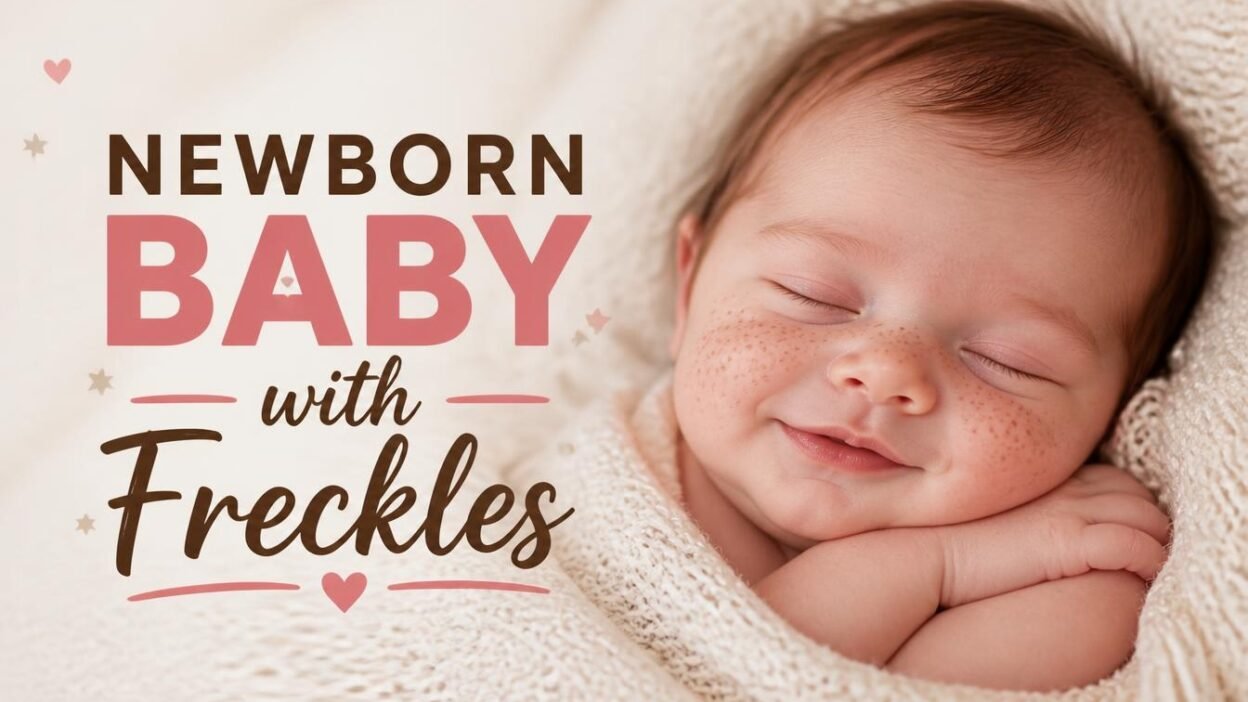
Parents spend hours inspection their baby’s face and body, so it’s not surprising to see little brown spots that resemble freckles. Having a newborn baby with freckles may be a cause for concern, as real freckles are associated with sun exposure, and a newborn baby has had minimal sun exposure.
Most spots on a newborn are harmless and are small brown ones. But they are not always freckles; they are actually other common skin pigmentations. The following are the answers to five important questions about these spots: What are they, why do they form, and when should they be checked?
Is it normal for newborn babies to have freckles?
Is it normal for newborn babies to have freckles? The scientific term for ‘true’ freckles is ‘ephelides’ and they’re actually rare to be born with. They develop when skin is exposed to sunlight and usually first appear in early childhood, typically between about 2 and 4 years of age – especially in children with fair skin.
It basically means that a newborn with freckled spots is most likely not freckles, but rather a totally different kind of spot. The majority of these are harmless and normal, but some can sometimes be associated with other conditions, so it is prudent to make note of any unusual spots when these are seen in your baby’s routine examinations.
Why Does My Newborn Baby Have Freckles?
When you ask me “why does my newborn baby have freckles,” they are probably caused by one of the following reasons:
- Smooth or irregular-edged, flat light brown spots. They are common and usually you have one or two.
- Congenital moles (congenital melanocytic naevi): Brown or black spots that are present at birth in about 1 to 2 percent of newborns. The majority are small and harmless.
- Transient neonatal pustular melanosis: Small harmless blisters or pustules present at birth which go away and leave behind a small brown spot. Occurs more often in darker skinned babies and the spots typically fade in weeks to months.
- Congenital dermal melanocytosis: Blue-grey discoloration, usually on the bottom or lower back, which was previously referred to as Mongolian spots. Very common in dark-skinned babies and typically disappear before early childhood.
- Lentigines: Small, flat, dark-brown spots which resemble freckles but do not darken with sun. Some of them are harmless, a few are not.
What are the causes of Freckles in Babies?

There are two main reasons for freckles in babies and young children – genetics and sun exposure.
Freckles are caused by melanocytes (pigment-producing skin cells) making more melanin in small, localised areas of skin in response to ultraviolet (UV) radiation. Freckling is a more hereditary trait for some people. The variation of a gene called MC1R which is also linked to red hair and fair skin is strongly associated with freckling. A child is more likely to freckle if his/her parents freckle.
But babies don’t get freckles unless they have been outside and exposed to the sun, as UV exposure is necessary. Freckles often get darker during the summer and lighter during the winter.
Remember, baby skins are sensitive to sun and don’t need direct sun. Shade, light-colored clothing, covering arms and legs, and a wide brimmed hat. Ask your doctor before using sunscreen on babies younger than six months.
What is the cause of the pigmentation of the skin of newborn babies?
Babies’ skin coloration remains variable for the first few months of life. Some babies are born lighter skinned than they will get, since melanin will gradually increase after birth. The skin around the ears, eyes, nails and genitalia will change color before other areas of the body, and the color of these areas can indicate what the baby’s skin will look like when it’s fully grown.
Temporary dark skin in some parts of the body, such as a line of dark skin down the middle of the tummy and in the genitals, may also be present in some newborns. This occurs due to the mother’s hormones during pregnancy and typically goes away over time.
Small spots may change in appearance in the first year since they are the development of the skin. The pigment changes in most baby’s is a completely normal phenomenon.
When to seek medical attention for freckles on newborn baby?
While most freckles on a baby are harmless, seek the advice of his or her doctor if the freckles include:
- Brown or light brown spots that are found on the skin. They can be present in the skin in groups of 6 or more, and can sometimes be a feature of a genetic condition called neurofibromatosis type 1.
- Larger congenital moles require regular monitoring, and are termed a large mole or birthmark
- A growth that increases in size, changes in color, form or becomes raised or irregular
- A spot that is bleeding, itching or red and inflamed
- Freckle-like spots in the armpits or groin, which may need further assessment
- Multiple dark spots that occur at the same time, or dark spots with other health issues
Your doctor can check the spots and, if necessary, your baby will be referred to a paediatric dermatologist. Clear photographs can be taken over time to monitor any changes.
Conclusion
Generally, seeing a baby that appears to be a newborn with freckles is nothing to worry about. Even though they may look like freckles, they typically don’t begin to occur until early childhood when the child gets sun. Brown spots on a newborn are more often café-au-lait spots, small congenital moles or temporary pigmentation that fades over time. Keep your baby’s skin covered from the sun, watch for any spots as your baby gets older and get your doctor’s opinion about any spots that change, grow or appear in a large number.
FAQ’S
When do babies get freckles?
Babies usually don’t get freckles in the first year of life. True freckles (ephelides) develop in response to sun exposure and typically first appear in early childhood, between about 2 and 4 years of age. They are most common in children with fair skin, and they tend to get darker in summer and fade in winter.
When do freckles appear on babies?
Freckles appear once a child has had enough UV exposure to trigger extra melanin production in small patches of skin. Genetics also plays a role: a variation in the MC1R gene, which is linked to red hair and fair skin, makes freckling more likely, so a child with freckled parents is more likely to develop them. If your baby has brown spots earlier than this, they are usually a different kind of pigmentation, such as café-au-lait spots or small congenital moles.
Can babies be born with freckles?
It’s very rare. True freckles need sun exposure, and a newborn has had almost none. Brown spots that look like freckles on a newborn are usually something else, such as congenital moles (present in about 1 to 2 percent of newborns), café-au-lait spots, or temporary marks left by transient neonatal pustular melanosis. Most are harmless, but it’s sensible to mention any new spots at your baby’s routine check-ups. See a doctor if you notice six or more light brown spots, spots that grow, change color or become raised, or spots that bleed, itch or look inflamed.
What age do babies get freckles?
Most children get their first freckles between ages 2 and 4, though it varies with skin tone, family history and how much sun they get. Babies’ skin is very sensitive to sun, so keep them in the shade, dress them in light-colored clothing that covers arms and legs, and use a wide-brimmed hat. Ask your doctor before using sunscreen on a baby younger than six months.

“Hi, I’m Maya! As a mother and a passionate advocate for maternal health, I created Pregnancy Matter to be the safe space I wish I had while expecting. Through sleepless nights, endless Google searches, and the incredible journey of motherhood, I’m here to share real-talk, expert-backed insights, and a comforting hand to hold through every trimester.”



[…] the first few weeks or months, but when it’s still present, it’s one of the miniscule pleasures of being a newborn parent. If your baby has an odd or bad smell, seek your doctor’s […]