
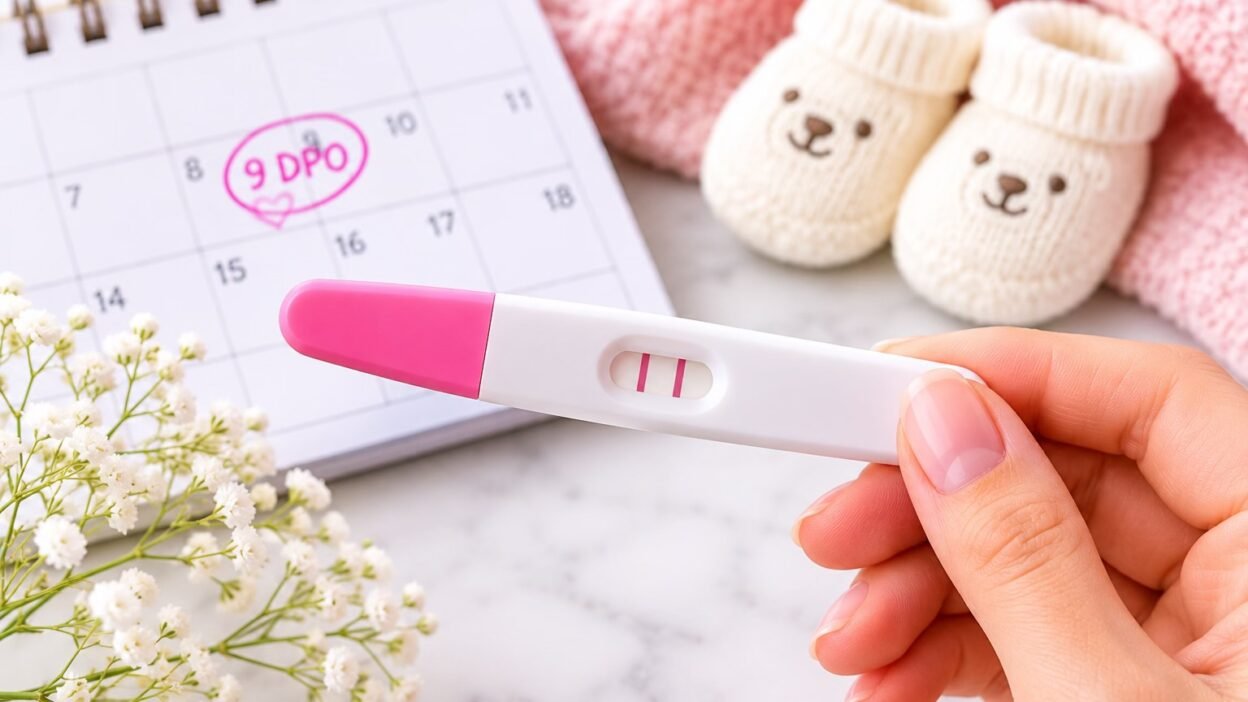
Two weeks after ovulation is the longest of any cycle. It’s about nine days after ovulation (9 DPO) that many women struggle to withhold themselves from taking a test, particularly if they have some cramps, fatigue or other potential early signs.
Yes, you can take a 9 DPO pregnancy test, however, it is too early. A positive will depend on time of implantation and amount of hCG produced (hCG is a hormone produced by the pituitary gland within your system). This guide has answers to six common questions regarding testing at 9 DPO – such as what a positive or negative test result means and when to test again.
What Is The Definition Of 9 DPO?
The term “days past ovulation” (DPO) refers to the number of days that have elapsed since ovulation. 9 DPO means 9 Days Post Ovulation as it is 9 days since you ovulated an egg. Fertilisation would have taken place in about 24 hours of ovulation if it had taken place.
A normal 28 day cycle has ovulation occurring around day 14, making 9 DPO approximately day 23. This is approximately 5 days prior to your period. If you’re pregnant, you’d be about 3 weeks and 2 days, counting from the first day of your last period.
Remember, ovulation may not occur on day 14. Unless you are using ovulation tests or basal body temperature, your real DPO may not be what you believe it to be.
Can a 9 DPO Pregnancy Test Be Positive?
Yes, but just some women. A pregnancy test measures the level of a hormone called human chorionic gonadotropin (hCG) which is only made when a fertilised egg has attached to the lining of the uterus.
- It typically takes 6-12 days after ovulation for implantation to occur, with days 8-10 being most likely. This implies that at 9 DPO:
- If the implantation occurred early, between 6-7 DPO, the hCG may have already increased to the level of being detected on a sensitive test.
- If the implantation occurred between 8-9 DPO, then the production of hCG should only have just started and is unlikely to be detectable.
- There is no hCG to test for if it has not been implanted.
This is why most pregnant women will still have a negative test reading at 9 DPO. It is possible to have a positive at this point, but the exception, not the rule.
What Are hCG Levels At 9DPO?
Once the embryo is in place, hCG begins at very low levels and doubles every 2-3 days during early pregnancy. Levels at 9 DPO are usually less than 5-10 mIU/mL and in many pregnancies, hCG may not be detectable at all yet.
The typical home pregnancy test can measure hCG levels of approximately 20-25 mIU/mL. Some early result tests are more sensitive, detecting low levels (10 mIU/mL), and therefore have a higher likelihood of catching pregnancy before the period is missed. Despite this, early tests at 9 DPO don’t always catch a pregnancy, as the hCG isn’t yet high enough to measure.
Even though a blood test at a clinic can measure smaller levels of hCG, blood tests might not show a result this early if it is only just beginning to implant.
Is Negative Test at 9 DPO a negative pregnancy test?
No. A negative 9 DPO pregnancy test does not rule out pregnancy. It most often means that it’s too early to tell.
Some causes for a negative test at 9 DPO are:
- Not yet but very recently, the implantation has not taken place.
- hCG is still below the test’s detection level
- You have missed your period and are less than 9 days past ovulation (DPO)
- A large amount of fluid was taken in prior to the test, which is why your urine was diluted.
- Test was not as sensitive, e.g., a standard test vs an early-result test
There are many women who may test negative at 9 DPO and then end up testing positive a couple days later.
What is the meaning of a faint line on the 9 DPO?
When a faint line does show up in the time window indicated in the instructions it typically indicates the presence of hCG, although it may be present in low levels. A faint line on pregnancy test is typical during early pregnancy as levels of hCG are still increasing. If levels are rising at the expected rate, there should be a darker line upon retesting within 2-3 days.
There are a couple of points to note, however:
- Evaporation Lines: A very light trace of colourless residue that is seen after the reading window is passed is a negative result.
- Chemical pregnancy: A very early pregnancy sometimes stops developing soon after it has been implanted. A faint positive could be followed by a negative test and a slightly early or late period.
- Fertility medications: Certain fertility medications contain hCG, which may lead to a false positive if you test too early after taking the medication.
A repeat test a few days later or a blood test from a doctor can confirm the test if it’s faint positive.
When Is the Best Time to Take a Pregnancy Test After Ovulation?
The best time to get the most accurate results is the first day of your missed period, or approximately 14 DPO. By this point, most pregnant women will have secreted enough hCG to give a definite positive result on a home test.
If you’re interested, these are some tips for testing earlier:
- Employ a low detection limit early-result test.
- Use the first urine of the day as it is the most concentrated.
- Do not consume a lot of fluids prior to testing.
- Read the result in the given time frame.
- If negative, retest in 2-3 days or wait until your period is due.
If your period is more than a week late and your tests continue to be negative, consult with your doctor. Get medical assistance ASAP if the abdominal pain is severe, or one sided, or if the shoulder tip is painful or drowsy, regardless of the test result.
Conclusion
A 9 DPO pregnancy test can occasionally show a positive result, but for most women it is simply too early. Implantation often happens around 8 to 10 days after ovulation, and hCG then needs a few more days to reach a level that home tests can detect. A negative result at 9 DPO doesn’t mean you aren’t pregnant. If you can, wait until the day of your missed period for the most accurate answer, or retest every two to three days if you’ve already tested early. Your healthcare provider can confirm the result and guide you on the next steps.

“Hi, I’m Maya! As a mother and a passionate advocate for maternal health, I created Pregnancy Matter to be the safe space I wish I had while expecting. Through sleepless nights, endless Google searches, and the incredible journey of motherhood, I’m here to share real-talk, expert-backed insights, and a comforting hand to hold through every trimester.”



[…] realizing that they are ovulating: Many do not experience any signs of ovulation. There are certain scenarios when it is important to […]